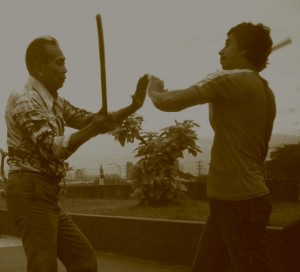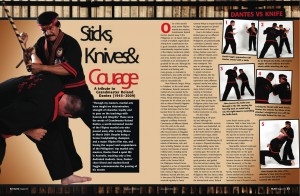
Tribute to Grandmaster Roland Dantes (1945 – 2009) by David Foggie for Blitz Australasian Martial Arts Magazine

Master Roland Dantes by David Foggie for Blitz Australia Magazine 2012 Master Roland Dantes by David Foggie for Blitz Australia Magazine 2012

Tribute to Grandmaster Roland Dantes by David Foggie for Blitz Australasian Martial Arts Magazine. David Foggie was a close friend and student of the Legendary Grandmaster Roland Dantes. Permission given to Mandirigma.org to reprint the Blitz Australasian Martial Arts Magazine given by David Foggie.       … [Read more...]
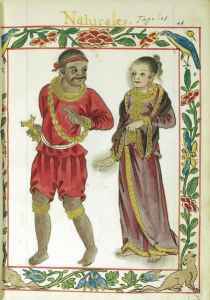
Boxer Codex Manuscript – circa 1595

Tagalog royalty mandirigma.org

Boxer Codex Boxer Codex is a manuscript written circa 1595 which contains illustrations of Filipinos at the time of their initial contact with the Spanish. Aside from a description of and historical allusions to the Philippines and various other Far Eastern countries, it also contains seventy-five colored drawings of the inhabitants of these regions and their distinctive costumes. Fifteen illustrations deal with Filipinos. [1] It is believed that the original owner of the manuscript was Luis Pérez das Mariñas, son of Governor General Gómez Pérez das Mariñas, who was killed in 1593 by the Sangleys (Chinese living in the Philippines). Luis succeeded his father in office as Governor General of the Philippines. Since Spanish colonial governors were required to supply written reports on the territotries they governed, it is likely that the manuscript was written under the orders of the governor. [2] The manuscript's earliest known owner was Lord Ilchester. The codex was among what remained in his collection when his estate, Holland House in London, suffered a direct hit during an air raid 1942. The manuscript was auctioned in 1947 and came into the possession of Prof. Charles R. Boxer, an authority on the Far East. It is now owned by the Lilly Library at Indiana University. [3] The Boxer Codex depicts the Tagalogs, Visayans, Zambals, Cagayanons and Negritos of the Philippines in vivid colors. Except for the Chinese, however, its illustrations of inhabitants of neighboring countries are odd looking. This suggests that the artist did not actually visit the places mentioned from the text, but drew from imagination. Boxer notes that the descriptions of these countries are not original. The account of China, for example, was largely based on the narrative of Fray Martin de Rada. The technique of the paintings suggests that artist may have been Chinese, as does the use of Chinese paper, ink and paints. [4]   Native Pre-colonial inhabitants of the Philippines   Tagalog royalty and his wife, wearing the distinctive color of his class (red).   Tagalog maginoo (noble) and his wife, wearing the distinctive color of his class (blue.   A timawa or tumao (noble) couple, Visayan Pintados   Visayan kadatuan (royal) couple . References ^ Alfredo R. Roces, et. al., eds., Boxer Codex in Filipino Heritage: the Making of a Nation, Philippines: Lahing Pilipino Publishing, Inc., 1977, Vol. IV, p. 1003. ^ Ibid., p. 1004. ^ Ibid., p. 1003. ^ Ibid.     … [Read more...]
THE SIGLO DE ORO – The Golden Age of Spain in the fields of Military and Naval power, international politics, economy, arts, literature, and music. 15th – 17th Centuries.

The Siglo de Oro-mandirigma.org

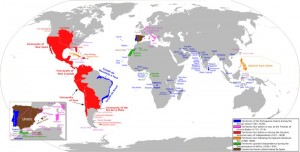
THE SIGLO DE ORO The Siglo de Oro is the Golden Age of Spain in the fields of Military and Naval power, international politics, economy, arts, literature, and music. The actual length of Spain's golden age lasted for more than a hundred years, from 15th to the 17th Centuries. The above photo shows the areas of the world that at one time were territories of the Spanish Monarchy or Empire. The Spanish empire reached its greatest extent during the Siglo de Oro. … [Read more...]
Glendale FMA Academy proudly presents an Invitation Only Ilustrisimo Seminar with Guro Brandon Ricketts. Glendale, California. Saturday, September, 2012

guro brandon-ricketts-ilustrisimo-2

Glendale FMA Academy proudly presents an Invitation Only Ilustrisimo Seminar with Guro Brandon Ricketts. Glendale, California. Saturday, September, 2012 Guro Brandon Ricketts will be conducting a training seminar on the style of Tatang Illustrisimo (as taught by the late GM Topher Ricketts) on Saturday, September, 2012. Guro Brandon will be assisted by Guro Dino Flores.  The seminar is by invitation only and not open to the general public . It will be held at the Glendale FMA Academy.         … [Read more...]
Las Vegas Open Invitational Stick-Knife Tournament in Las Vegas, Nevada. Sunday, November 11th, 2012.

kapisanang-mandirigma-las-vegas-kali-arnis-eskrima 2012 - kapisanang-mandirigma-las-vegas-kali-arnis-eskrima 2012

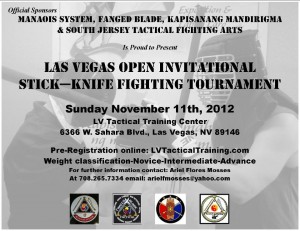
  Las Vegas Open Invitational Stick-Knife Tournament. Sunday, November 11th, 2012. Sponsored by Manaois Systems, Fanged Blade, Kapisanang Mandirigma and South Jersey Tactical Fighting Arts For more information: Contact: Ariel Flores Mosses LV Tactical Training Center 6366 W. Sahara, Las Vegas, NV 89146 Email: arielfmosses@yahoo.com Phone: (702) 533-9688 http://www.lvtacticaltraining.com/#!events … [Read more...]
The Combat Academy presents a Kapisanang Mandirigma Seminar with Guro Dino Flores in Cuernavaca City, Mexico, October 6 & 7, 2012

KAPISANANG-MANDIRIGMA-MEXICO-lameco-ilustrisimo-ricketts-sulite-kali-arnis-eskrima-philippines-KAPISANANG-MANDIRIGMA-MEXICO-lameco-ilustrisimo-ricketts-sulite-kali-arnis-eskrima-philippines

  The Combat Academy presents a Kapisanang Mandirigma Seminar with Guro Dino Flores in Cuernavaca City, Mexico, October 6 & 7, 2012. Guro Dino Flores will be sharing some of his experience in Ilustrisimo and Backyard Lameco Eskrima. For more information contact Alex Garduño at the Combat Academy.   About Guro Dino: Guro Dino began informally training in the Philippines with family and  family friends in balisong for the streets. Guro Dino trained for many years with Grandmaster Conrad A. Manaois in Ninoy Cinco Teros Arnis and Master Henry Bio in Sikaran Arnis in the 1980′s along with his cousins Ariel Flores Mosses and Choy Flores. In the early 1990′s he was accepted as an initial member of Punong Guro Edgar Sulites’ newly forming Backyard Group AKA the Sulite Oriehenal Group At the recommendation of Punong Guro Sulite, Guro Dino first visited Master Christopher Ricketts in the Philippines in 1995 and was introduced to his perspective on the Warrior Arts.  Since the passing of Punong Guro Sulite,  he has continuously train in Kali Ilustrisimo Under Master Christopher Ricketts, who gave Guro Dino permission to teach his method before his passing. Guro Dino was the Lameco representative for Master Ricketts and a member of Bakbakan Philippines sponsored by Master Ricketts. Guro Dino continues his training in Master Ricketts method of training with his two sons, the young Master Bruce Ricketts and Guro Brandon Ricketts. Guro Dino additionally had good fortune to experience training in Kali Ilustrisimo with Guro Dodong Sta. Iglesia, Grandmaster Rey Galang, Grandmaster Yuli Romo and Grandmaster Tony Diego. He also trained in Kali Ilustrisimo with one of his training partners and fellow Lameco Backyard member Guro Hans Tan, who was certified to teach Kali Ilustrsimo under Master Tony Diego. Additionally Guro Dino trained privately for several years in California and the Philippines with Professor Ireneo L. Olavides in Eskrima De Campo JDC-IO. About The Combat Academy: The “Combat Academy” was born in February of 2012 as an Independent training center after 17 years of work and continuous training. The Combat Academy curriculum includes Filipino Martial Arts (Lameco Eskrima & Doce Pares Eskrima), Muay Thai/Boxing, Sambo/ Jiu Jitsu, JKD and AMOK! Alex Garduño, Director and chief Instructor of the “Combat Academy”, is a Lameco Eskrima student under Guro Dave Gould and Guro Roger Agbulos, holds the Guro Rank in Doce Pares Eskrima under SGM Cacoy Cañete and He´s student of Tom Sotis in AMOK! … [Read more...]
Through sponsorship by Senator Miguel Zubiri – Arnis Officially Declared National Martial Art and Sport, Dec. 11 2009,

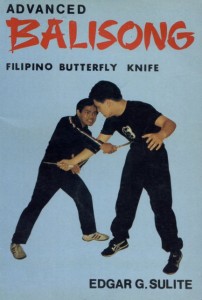
Lameco Sulite-advanced-balisong www.mandirigma.org

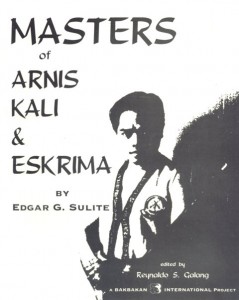
UPDATE ON LAWS PASSED DURING THE 14th & 15th CONGRESS Researched by the Executive-Legislative Liaison Service LAWS OF NATIONAL SIGNIFICANCE (15th CONGRESS)   RA 9850 AN ACT DECLARING ARNIS AS THE NATIONAL MARTIAL ART AND SPORT OF THE PHILIPPINES (SIGNED INTO LAW ON DECEMBER 11,  2009)   **********   The principal author and sponsor of RA 9850 is Senator Juan Miguel “Migz” F. Zubiri. He is a dedicated Martial Artist and Eskrimador. His primary teacher since childhood is Grandmaster Christopher Ricketts, founder of Bakbakan Philippines. System that he studied under Grandmaster Ricketts include Bakbakan Sagasa Kickboxing, Ngo Cho Kung Fu and Kali Ilustrisimo. Other teachers include Bakbakan Members Grandmaster Alex Co (Ngo Cho), Punong Guro Edgar G. Sulite (Lameco Eskrima), Grandmaster Tony Diego (Kali Ilustrisimo) and Grandmaster Antonio Ilustrisimo himself.   Miguel with some of his teachers and fellow Bakbakan members.   On the cover of the "Advanced Balisong" book with one of his teachers, Punong Guro Edgar Sulite. Senator Juan Miguel F. Zubiri In 2008, Senator Juan Miguel “Migz” F. Zubiri, at age 39, became the youngest to be elected as Senate Majority Leader since the First Congress in 1946. A veteran legislator, he served the 3rd District of Bukidnon from 1998 to 2007 and was always cited as one of the most outstanding solons in the House of Representatives. He has also maintained a perfect attendance in the Plenary Sessions for the last 12 years (4 Congresses) both as Congressman and as Senator, and including this 15th Congress. In the 14th Congress and during his stint as Senate Majority Leader, Sen. Zubiri helped steer the Senate to a record performance of around 650 bills enacted into laws. Sen. Migz is the principal author and sponsor of more than 20 major laws, both in the Senate and during his stint as Congressman. As a fervent advocate of clean energy, he worked for the passage of RA 9513 or the Renewable Energy Act of 2008 and RA 9367 or the Biofuels Act of 2006, earning him the moniker Mr. Clean Energy. Among the other laws he sponsored, principally authored or co-authored are:   RA10068 – Organic Agriculture Act of 2010; RA 9147 – Wildlife Conservation and Protection Act; RA 10121 – Philippine Disaster Risk Management Act; RA 9165 – Comprehensive Dangerous Drugs Act of 2002; RA 9679 – the Home Development Mutual Fund Law of 2009 (Pag-IBIG Fund); RA 9653 – the Rent Control Act of 2009; RA 9997 – the National Commission on Muslim Filipinos Act of 2009; RA 9996 – the Mindanao Development Authority Act of 2010; RA 9904 – the Magna Carta for Homeowners and Homeowners’ Associations; RA 9903 – Condonation of Penalties on Delinquent Social Security Contributions; RA 9507 – the Socialized and Low-Cost Housing Loan Condonation Program; RA 9850 – Declaring Arnis as the National Martial Art and Sport; RA 9500 – UP Charter Amendments; RA 9163 – National Service Training Program; RA 9166 – Armed Forces of the Philippines Rate Pay Base Increase Act; RA 10072 – the New Charter of the Philippine Red Cross; RA 9645 – Declaring July 27 of Every Year as Araw ng Iglesia Ni Cristo and as Special Working Holiday; and RA 9849 – Declaring Eidul Adha as a National Holiday. He is also considered the “father” of the New Cooperative Code being the principal sponsor and author of RA 9520 or the Philippine Cooperative Code of 2008. Sen. Migz is known as a champion of environmental concerns, an advocacy he pursues in the Senate and among his top legislative agenda. In the current 15th Congress, he chairs the Committee on Environment and Natural Resources. He also chairs the Committee on Cooperatives and 3 Joint Congressional Oversight Committees such as the Joint Congressional Oversight Committee on the Ecological Solid Waste Management Act; Joint Congressional Committee on Clean Air Act; and the Joint Congressional Oversight Committee on Cooperatives. He is also a member of 20 other Senate standing committees. Sen. Migz is involved in concrete environmental programs such as being the founder of the Philippine Deer Foundation, a deer conservation project, and as President of the Palawan-based Katala Foundation which protects endangered wildlife species and their habitats. A trained first aider and certified rescue diver, he is a Governor of the Philippine Red Cross and active member of the Red Cross Youth Committee and Concerned Divers of the Philippines. Senator Zubiri has published two books: the Philippine Cooperative Code of 2008, and Bukidnon: The Philippine Frontier. He is a graduate of Master’s in Environment and Natural Resources Management at the University of the Philippines Open University and Bachelor of Science in Agri-Business Management at the University of the Philippines in Los Baños. He has also been conferred four Honorary or Honoris Causa Doctoral … [Read more...]
Kapisanang Mandirigma and LV Tactical Training presents Guro Dino Flores and Guro Ariel Flores Mosses Seminar. Las Vegas, Nevada, Saturday, September 22, 2012

Kapisanang Mandirigma and LV Tactical Training presents Guro Dino Flores and Guro Ariel Flores Mosses Seminar. Las Vegas, Nevada, Saturday, September 22, 2012 Kapisanang Mandirigma and LV Tactical Training presents Guro Dino Flores and Guro Ariel Flores Mosses Seminar. Las Vegas, Nevada, Saturday, September 22, 2012

Kapisanang Mandirigma and LV Tactical Training presents Guro Dino Flores and Guro Ariel Flores Mosses Seminar.Las Vegas, Nevada, Saturday, September 22, 2012  … [Read more...]
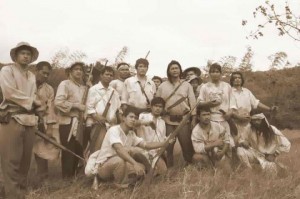
Movie: Supremo (2012), Andres Bonifacio as husband, brother, soldier and hero

supremo movie 2012 katipunan pilipinas supremo movie 2012 katipunan pilipinas supremo movie 2012 katipunan pilipinas supremo movie 2012 katipunan pilipinas supremo movie 2012 katipunan pilipinas supremo movie 2012 katipunan pilipinas

http://youtu.be/oHQ34CKnkIM     About Andres Bonifacio's Biopic Description Andres Bonifacio as husband, brother, soldier and hero Release date August 2012 Genre Epic Drama Studio Alternative Vision Cinema and Strawdogs Studio Productions Plot outline Manila, year 1896. The cry for independence from the tyranny of Spain peals louder than ever. Andres Bonifacio, leader of the rebel movement the Katipunan, leads his men to war. Though ill-equipped and untried in the field of battle, the Katipuneros launch an offensive against a vastly superior Spanish military. What follows is a series of events that will test the nation's brave sons, and an aftermath that will separate the genuine patriots from mere participants. Starring Alfred Vargas, Mon Confiado, Nicco Manalo, Alex Vincent Medina, Edmon Romawac, Shielbert Manuel, Lehner Mendoza, Manu Respall, Jeff Fernandez, Banjo Romero, Alex Cabodil, Nica Naval and Hermie Concepcion Directed by Richard V. Somes Written By Jimmy Flores Produced by PM Vargas, Alfred Vargas, Riza Montelibano, Mai Montelibano and Ellen Ilagan   Supremo (2012) Full Trailer Director: Richard V. Somes Starring: Alfred Vargas Mon Confiado Hermie Concepcion Nicco Manalo Alex Vincent Medina Nica Naval Edmon Romawag Shielbert Manuel Lehner Mendoza Jeff Fernandez Banjo Romero Mano Respall Alex Cabodil Production Manager: Darryl De la Cruz Sound Engineer Jedd Chriss Dumaguina Musical Scorer: Von De Guzman Editors: Carlo Francisco Manatad + Joris Fernandez Director of Photography: Alex Espartero Production Designers: Erin John Martir + Adrian Torres Screenplay: Jimmy Flores Associate Producer: Ellen Ilagan + Maimai Montelibano Line Producer: Riza Montelibano Executive Producers: PM Vargas + Alfred Vargas   http://www.facebook.com/pages/Supremo/407515249292352     … [Read more...]
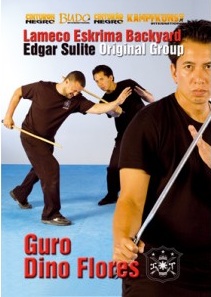
Guro Dino Flores DVD Release and Magazine article for Budo International, November 2011

dvd-lameco-eskrima-backyard-sulite-original-group www.mandirigma.org

Guro Dino Flores DVD Release and Magazine article for Budo International, November 2011 February 1, 2012 By dinof2 Leave a Comment (Edit) Guro Dino Flores DVD Release and Magazine  article for Budo International, November 2011     Excerpt from the DVD backcover: Punong Guro Edgar Sulite was one of the great revolutionaries in Philippine Martial Arts history. There were two types of students that learnt under him, those who took classes under him periodically and those whom he selected and prepared personally for becoming fighters in private training sessions in the backyard of his home, these students belonged to the Sulite Orihinal Group. Dino Flores belongs to this second elite group of specially trained fighters in Lameco and shines with his own light as one of the top selected fighters of the Lameco Eskrima backyard group. In this work he introduces and shows us a series of exercises which Punong Guro Sulite emphasized greatly upon and that develop correct distancing in a real combat situation. This dvd will help you refine the combative motions, enable you to increase the intensity within a drill, as well as show you how to use equipment correctly and help you overcome a well protected opponent. You will learn how to avoid being hit and grabbed. These exercises practiced under real contact and tension will allow you to react against the most common attacks in real time and in an effective way. The most important thing is to hit well, to have good footwork and mainly to have a great foundation. http://www.budointernational.net/arnis-kali-escrima/1564-dvd-lameco-eskrima-backyard-sulite-original-group.html     About Budo International Magazine Budo International is the only martial arts magazine published in seven different languages (English, Spanish, French, Italian, Portuguese, German, and Croatian) and sold worldwide. Budo Magazine is undisputedly the largest specialized magazine in over 60 countries. They are the foremost martial arts publication in Europe, South America, Central America and Australia, as well as having editions in Greece and Czechoslovakia.Their monthly publication brings exciting and exotic masters and material that is truly universal. Budo also covers all types of events, from tournaments to movies and the magazine brings a gust of fresh air mixed with European quality to the American culture. Click on the magazine image below to read English issues of Budo. http://www.budointernational.net/   http://youtu.be/_F-WsyfWAhs   Backyard Lameco DVD clip produced by Budo International … [Read more...]
Interview: Guro Dino Flores by Christof Froehlich, March 2012

solo-mandirigma-institute kali arnis escrima lameco solo-mandirigma-institute kali arnis escrima lameco

Interview: Guro Dino Flores by Christof Froehlich, March 2012 Q: Guro Dino, please introduce yourself. Guro Dino: I am Guro Dino Flores and I am a member of the organization Kapisanang Mandirigma. I was a member of the late Punong Guro Edgar Sulite’s Backyard Group, also known as the Lameco SOG (Sulite Orehenal Group). I am also a practitioner of Ilustrisimo taught primarily by the late Master Christopher Ricketts. — Q: How did you first start in the Warrior Arts of the Philippines? Guro Dino: I was first introduced to the existence of the Philippine Warrior Art in 1975 by my father. As a child, my father would tell me stories about the battles against the Spanish and Americans during the struggle for Philippine independence. Some of the stories he told were of his grandfather, Segundo Morato Flores, who was a Katipunero in the Bicol Province during the Philippine Revolution. His grandfather would proudly celebrate Philippine independence day by putting on his Katipunero uniform. He would dress my father in a matching outfit and wooden sword. Then with great pride they would march to the town square and meet with other veterans. Other stories involved my paternal grandfather, as a decorated Captain in the USAFFE (United States Armed Forces in the Far East). He was also a guerilla fighter after the Americans surrendered with the fall of the Philippines to Japan. On my mothers side, my grandfather fought on the Island Fortress of Corrigador as a staff sergeant in the USAFFE where he was in charge of a unit of 50 caliber water cooled machine guns. He survived the infamous Bataan “Death March” and numerous solo recon missions. One day during story time, my father showed me the sword my paternal grandfather used in World War II. It was in a leather scabbard and had a water buffalo horn handle (Kalabaw). He held it proudly over his head pointing to the sky telling me these swords were used in “Filipino Arnis”! He did a few fighting stances, and that was how the seeds of the Philippine Warrior Arts were first planted in me. My first instruction was in the early 80′s as a young teen in my mother’s province of Laguna, Philippines. I had bought my first Balisong knife and would practice with it constantly. The town of Balisong where the knife was invented was less than 30 miles away in my maternal grandmothers province of Batangas. Laguna was known for practitioners of the balisong knife and there was an abundance of these knives available at the traditioal outdoor market (Palenke). One day, I way fooling around with the knife in front of my uncles who were having a “Tagay” or loosely translated, a serious drinking session. They yelled at me that the balisong wasn’t a toy and that relatives have been seriously injured in knife encounters. One of their friends showed me his scar from a knife fight. This began my “informal lessons” in the knife arts. One of the first lessons was to “never brandish that thing unless you plan to use it”. When I moved to Los Angeles in the late 80′s, my cousins, Ariel Flores Mosses and Choy Flores and I would train with each other. Our first “formal studies” in Eskrima were with Grandmaster Henry Bio in Sikaran Arnis and Grandmaster Conrad Manaois in his family system of Ninoy Cinco Teros. — Q: Can you tell us some things about your training with Punong Guro Edgar Sulite & Master Christopher Ricketts. Guro Dino: They were both in love with the Philippine Warrior Arts. Both were very attentive and respectful of the proper form and function of the fundamental and original movements taught to them. From my first day to my last day of training with them, we always began with the basic foundations. They were both at the conclusion that real fighting must be kept simple. One of the primary things Punong Guro focused on with the Backyard Group was sparring at various levels of intensity. Frequently with live stick with full punching, kicking, elbows, knees, takedowns and grappling permitted. Even though he acknowledged that the sword was the soul of the art, he found sword techniques did not always work with a stick in these conditions, especially with headgear. It was an amazing learning opportunity for me. Master Ricketts’ primary focus became the perfection and preservation of the original ways Grandmaster Ilustrisimo actually moved with his sword. He constantly sought to master these techniques even further, and this is what he wanted me to perfect. When I first met Master Ricketts in the Philippines, within minutes I was sparring some of his senior students. He was a big believer in the importance of physical conditioning and sparring. It was an honor and privilege to train with these Grandmasters and I miss my friends dearly. I miss being their student. I will always do my best to conduct myself in a way that they would make them proud and do my part to keep their legacy … [Read more...]
Kapisanang Mandirigma and LV Tactical Training presents Guro Dino Flores and Guro Ariel Flores Mosses Seminar in Las Vegas, Nevada, July 29, 2012

backyard lameco guro dino guro ariel kali arnis escrima backyard lameco guro dino guro ariel kali arnis escrima

Seminar Series. Instructors: Guro Dino Flores & Guro Ariel Flores Mosses Date: July 29, 2012 Location: LV Tactical Training Facility 6366 W. Sahara Las Vegas, NV 89146 Time:  10:00am-3:00pm Cost:  $99.00 per person Contact:  Ariel Flores Mosses – email arielfmosses@yahoo.com http://www.lvtacticaltraining.com/#!events About Guro Ariel: Guro Ariel F. Mosses has over 30 years of Filipino Martial Arts experience. He has trained under Filipino Hall of Fame Grand Master Conrad A. Manaois, the late Punong Guro Edgar G. Sulite, and Grand Master Christopher Ricketts of Kali Ilustrisimo. Guro Mosses is the Vice President and Chief Instructor for Manaois Systems International. He holds a 7th degree in Kali Jukune Do. Guro Ariel is a member of Kapisanang Mandirigma. He has experience as a professional bodyguard and is a former police officer. Guro Ariel is currently teaching at LV Tactical Training in Las Vegas, Nevada.   About Guro Dino: Guro Dino trained for many years with Grandmaster Conrad A. Manaois in Ninoy Cinco Teros Arnis and Master Henry Bio in Sikaran Arnis in the 1980′s along with his cousins Ariel Flores Mosses and Choy Flores. In the early 1990′s he was accepted as an initial member of Punong Guro Edgar Sulites’ newly forming Backyard Group AKA the Sulite Oriehenal Group At the recommendation of Punong Guro Sulite, Guro Dino first visited Master Christopher Ricketts in the Philippines in 1995 and was introduced to his perspective on the Warrior Arts.  Since the passing of Punong Guro Sulite,  he has continuously train in Kali Ilustrisimo Under Master Christopher Ricketts, who gave Guro Dino permission to teach his method before his passing. Guro Dino was the Lameco representative for Master Ricketts and a member of Bakbakan Philippines sponsored by Master Ricketts. Guro Dino continues his training in Master Ricketts method of training with his two sons, the young Masters Bruce and Guro Brandon Ricketts. Masters Bruce Ricketts and Guro Brandon Ricketts are now officially the head of the late Grandmaster Christopher Ricketts "Ilustrisimo" organization which strives to preserve the purity of the art. Guro Dino additionally had good fortune to experience training in Kali Ilustrisimo with Dodong Sta. Iglesia, Grandmaster Rey Galang, Grandmaster Yuli Romo and Grandmaster Tony Diego. He also trained in Kali Ilustrisimo with one of his training partners and fellow Lameco Backyard member Guro Hans Tan, who was certified to teach Kali Ilustrsimo under Master Tony Diego.Additionally Guro Dino trained privately for several years in California and the Philippines with Professor Ireneo L. Olavides in Eskrima De Campo JDC-IO. Guro Dino also cites the importance of his training partners in Lameco SOG and Kapisanang Mandirigma in his growth. After the passing of Punong Guro Edgar Sulite, certain members of the Lameco Backyard group reformed also became know as Kapisanang Mandirigma. The group regularly continued  training, sparring, experimenting and seeking the deeper roots of their chosen arts. This group includes Guros Joel Adriatico, Hospecio “Bud” Balani Jr., Mar Elepaño, Choy Flores, Arnold Noche, Gary Quan, Hans Anton Tan and Pantaleon “Mang Leo” Revilles, Jr. (RIP). With frequent visits by Guro Lowell Pueblos, Guro Bong Hebia and honorary member Guro Ariel Flores Mosses. … [Read more...]
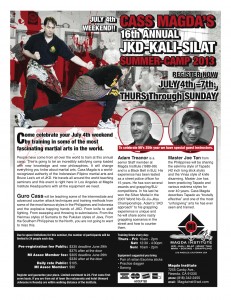
Master Joe Tan of Tapado/Vinas Eskrima to appear at Magda Institute Camp in California, July 4th – 7th, 2013

Master Joe Tan Seminar Kali Arnis Eskrima Vinas Tapado

Master Joe Tan of Tapado/Vinas Eskrima to appear at Magda Institute Camp, July 4th - 7th, 2013   … [Read more...]
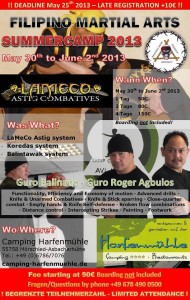
Guro Balinado of Balinado Arnis-Kursada & Guro Roger Agbulos of Lameco Astig Combatives teamed up to showcase FMA self-defense and combatives at the FILIPINO MARTIAL ARTS SUMMERCAMP IN GERMANY 2013

astig lameco

Guro Balinado of Balinado Arnis-Kursada & Guro Roger Agbulos of Lameco Astig Combatives teamed up to showcase FMA self-defense and combatives at the FILIPINO MARTIAL ARTS SUMMERCAMP 2013. https://www.facebook.com/events/358303297612020/   … [Read more...]
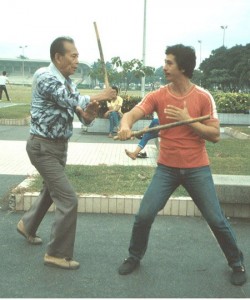
Protected: Invitation Only, Private Ilustrisimo Seminar – NEW DATES – Los Angeles & Las Vegas

Antonio-Tatang-Ilustrisimo_Tony-Diego

This post is password protected. To view it please enter your password below: Password: … [Read more...]
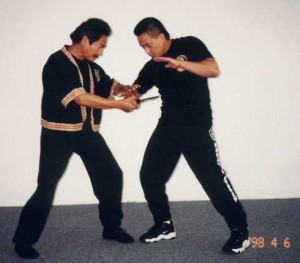
Film: Sisang Tabak – 1981

kali kali arnis arnis escrima escrima eskrima eskrima kali kali arnis arnis escrima escrima eskrima eskrima

http://www.youtube.com/watch?v=73mQS3CVoEw   Lots of Eskrima scenes. Mario (Orestes Ojeda) was forced by his mother, Dona Paula (Carmen Enriquez) to marry Lorna (Nyl Cavestany) and broke his intimate relationship with Sisa (Alma Moreno), a simple and poor girl was then pregnant with their child. Sisa gave birth to her child in the forest while being chased by Dona Paula's armed men. They were able to get her child and believed that she was already killed till they all witness her return and brave revenge as Sisang Tabak. Directed by Jose Miranda Cruz Alma Moreno Vic Vargas Dante Rivero Carmen Enriquez Orestes Ojeda Anna Gonzales … [Read more...]
Equipment

13626479_10206407883187198_9089580910213149058_n

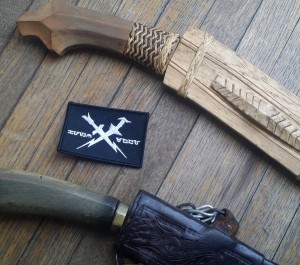
EQUIPMENT AVAILABLE Prices Reflect Delivery Fee **********************************************************  ITEM: Eskrima Hand Protector originally made for Master Ricketts – Made in Luzon, Philippines            DESCRIPTION: Hand Crafted in Luzon, Philippines by Eskrimadors. Tough but lighter than other hand guards for more agility.  Perfect for sparring. Only two available.     PRICE: Price – $45.00     **********************************************************   ITEM: Eskrima Forearm Protector/Armour, originally made for Master Ricketts  – Luzon, Philippines       DESCRIPTION: Hand Crafted in Luzon, Philippines by Eskrimadors. Tough but lighter than other forearm guards for more agility.  Perfect for sparring.     PRICE: Price – $45.00 **********************************************************   ITEM: Rattan Sticks: DESCRIPTION: Carefully selected by Eskrimadors in Cebu, Philippines to ensure that they are combat or training tough. PRICE: Price – $35.00 Pair   *********************************************************     ITEM: Pinuti Training Sword     DESCRIPTION: This STEEL training sword PINUTI is very popular in the VISAYAN central Philippines, imported from the Cebu, Philippines and hand-made by the craftsmen. Each features a design of the most common blades used by the Filipino Martial Arts practitioners around the world.This training blade feels real except its dull unsharpened edge. Heavy-duty hand crafted practice sword is built to last a lifetime! It features a 21 inch with dull edge & rounded tip, and aluminum cached and wooden handles. Comes with faux leather case with belt loop.     PRICE: Price – $75.00 Each (Training Sword Only)            **********************************************************     ITEM: Steel Training Dagger     DESCRIPTION: imported from the Cebu, Philippines and  hand-made by the craftsmen. This training blade is dull, unsharpened edge. Heavy Duty Steel. Heavy-duty hand crafted practice knife is built to last a lifetime! Aluminum cached and wooden handles. Comes with faux leather case with belt loop.     PRICE: Price – $25 Each       **********************************************************   **********************************************************     ITEM: Genuine Mini Classic Balisong     DESCRIPTION: Mini Balisongs. Hand Crafted in Barangay Balisong – the birthplace of the Balisong blade. Pure brass or Brass with wood inlay. Only 12 pieces available.     PRICE: Price – $20.00 Each       **********************************************************     ITEM: Genuine Balisong Comb     DESCRIPTION:  Awesome Balisong Comb. Handmade in Barangay Balisong. Rare and difficult to find Kamagong or Bahi wood Inlay. Very cool piece. $50 Stainless steel functional comb. only 3 pieces available.     PRICE: Price – $25.00 Each       **********************************************************     ITEM: Padded Sticks from Northern Luzon     DESCRIPTION:  Padded Sticks Imported from Luzon Philippines. Light Live Rattan stick core perfect for training. Only 6 available.     PRICE: Price – $29.00 Each,  Pair - $50.00     ********************************************************** **********************************************************     ITEM: T-Shirt – Kapisanang Mandirigma     DESCRIPTION: T-Shirt. Black with white print.     PRICE: Price – $25.00     **********************************************************   **********************************************************       ITEM: Patch – Kapisanang Mandirigma Patch     DESCRIPTION: Kapisanang Mandirigma Patch. Black and White.         PRICE: Price – $15.00   **********************************************************     **********************************************************         ITEM: Patch – Kapisanang Mandirigma Backyard Fighting Method  Patch. Represents the Sparring/Contact aspect of the art. Training type reserved for members.     DESCRIPTION: Kapisanang Mandirigma Backyard Fighting Method  Patch. Black and White.   **********************************************************   ITEM: Patch – … [Read more...]
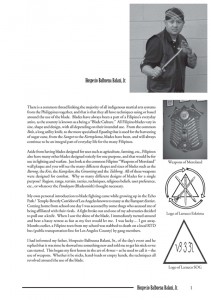
The FMA Informative has a Newspaper with information for the Filipino martial arts community, short stories, introductions of practitioners or styles, theories and/or technical aspects, short write ups on a past event etc, pertinent to the Filipino martial arts and the culture of the Philippine.

http://www.fmainformative.info/ http://www.fmainformative.info/

  The FMA Informative has a Newspaper with information for the Filipino martial arts community, short stories, introductions of practitioners or styles, theories and/or technical aspects, short write ups on a past event etc, pertinent to the Filipino martial arts and the culture of the Philippine. The FMA Informative also has an Online Magazine which each issue is dedicated to a subject such as certain aspects of a style, historical, theoretical and technical aspects, reflections, and other related subjects, also the culture of the Philippines etc... Both can be subscribed to for Free. The ideas and opinions expressed in the FMA Informative newspaper or online magazine are those of the authors of the articles or practitioners being interviewed and are not necessarily the views of the FMA Informative.   For more information go to their website: http://www.fmainformative.info/   Join FMA Informative on Facebook: http://www.facebook.com/pages/FMA-Informative/205930022842825 … [Read more...]
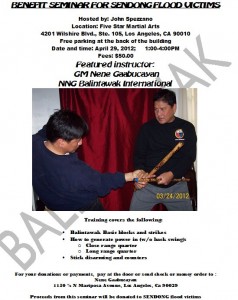
Grandmaster Nonato “Nene” Gaabucayan Sendong Flood Victims Benefit Seminar, April 29th, 2012

master nene gaabucayan nng balintawak arnis eskrima master nene gaabucayan nng balintawak arnis eskrima

  About Grandmaster Nonato "Nene" Gaabucayan "Standing at 5 feet, 2 inches tall and weighting no more that 120 pounds, Venancio "Anciong" Bacon was a very unassuming man. He was a veteran of a great many "death" matches in Cebu. Described by many of his students as lightning fast, Venancio Bacon maneuvered through a fight smoothly while exploiting his opponents’ balance and coordination. He was known to be very surgical with a stick, able to employ varying force to his exact targets throughout his adversary’s body. But, his greatest virtue and asset was his constant desire to innovate and improve his art, diligently discovering techniques through the years, never ceasing in this path. He taught his art to those who desired to learn it." At age 16, Nonato "Nene" Gaabucayan was introduced to Venancio "Anciong" Bacon's BALINTAWAK. In early 1976, "Nene" Gaabucayan moved to Cebu City from Cagayan de Oro to attend college. He lived in a boarding house owned by "Ben" Marapao in Urgello area. Upon learning that Nene was interested in continuing his Karate training, Dr. Marapao suggested he take up Eskrima. Nene attended one training session, in which he was given a demonstration by Teofilo Velez. He'd never seen anything like it, since then he had always been a loyal student and teacher of BALINTAWAK. Along with Teofilo Velez, Nene trained with Bobby Taboada, Chito Velez, Monnie Velez, Eddie Velez, Romeo de la Rosa, and Hector Rizzari. Training was hard, and he made a point to be there every day. Like a sponge, everybody poured whatever Balintawak knowledge they had to this very eager 16 year old. In return, he learned from them. At 18, Nene began teaching his own crop of students in Lapu-Lapu City. He divided his time between his studies at the Philippine Air Force College of Aeronautics and the YMCA in Lapu-Lapu. The photo below are some of his students, from left to right is Nonoy Patalinghug, Boy Booc (judo instructor), Nene, Dr. Marapao, Tonying Patalinghug, Fred Baguio, seated wearing a gi is Boy Baguio (karate instructor), seated wearing a jean jacket is Conrado "Condring" Ybanez (nephew of Tinong Ybanez). After completing his studies in Cebu, Nene returned to Cagayan de Oro. As one of Teofilo Velez' master instructors, he carried the Gold Chapter of Teovel Balintawak. He continued to teach Balintawak. In 1987, Nene traveled to Germany and later to Switzerland to teach BALINTAWAK. He stayed in Europe for 3 years, then returned to Cagayan de Oro. Nene has been teaching BALINTAWAK for 35 years.   For more information: http://www.nngbalintawak.com/index.html http://www.facebook.com/events/119784368151790/?notif_t=plan_edited … [Read more...]
The Origins of Philippines Boxing, 1899-1929

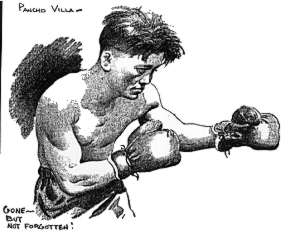
Pancho Villa by Ed Hughes1925 filipino boxing Pancho Villa by Ed Hughes1925 filipino boxing

The Origins of Philippines Boxing, 1899-1929   By Joseph R. Svinth Copyright © Joseph R. Svinth 2001. All rights reserved. The assistance of Pat Baptiste, Hank Kaplan, Paul Lou, Eric Madis, Curtis Narimatsu, John Ochs,  Michael Machado, and Kevin Smith is gratefully acknowledged. On June 18, 1923, Francisco "Pancho Villa" Guilledo beat Jimmy Wilde to become the world flyweight boxing champion, an accomplishment that was (and remains) a matter of great pride to people of Filipino descent. Unfortunately, while there has been some documentation of the many excellent Filipino boxers who subsequently followed Guilledo to the United States, there has not been as much attention paid to documenting the origins of boxing in the Philippines. This article represents a step toward correcting that omission. People with additional information or corrections are invited to contact the author at jsvinth@ejmas.com. "Pancho Villa, gone but not forgotten." Illustration by Ed Hughes, 1925. Boxing Enters the Philippines US servicemen introduced boxing to the Philippines during the late nineteenth and early twentieth centuries. How this came about is that on April 25, 1898, the United States declared war on Spain, whose colonial holdings included the Philippines. So, on April 27, 1898, Commodore George Dewey ordered his squadron of five cruisers and two gunboats to steam from China to the Philippines, and there, on May 1, 1898, he issued the famous command, "You may fire when ready, Gridley." The resulting US naval victory effectively ended Spanish control of the region, and in August 1898 the US Army began the occupation of Luzon. Then, to the horror of the Filipinos, the Americans did not cede the Philippines to them: instead they decided to keep the islands for themselves. Between 1899 and 1913, this resulted in savage wars of peace whose heroes included Emilio Aguinaldo on one side and Arthur MacArthur, Frederick Funston, Leonard Wood, and John J. Pershing on the other. Casualties in these battles were heavy and one-sided: US casualties were listed as 4,243 killed and 2,818 wounded in action while Filipino casualties are estimated at 16,000 killed, plus another several hundred thousand dead from famine or disease (generally cholera). However, after Theodore Roosevelt’s unilateral declaration of victory in July 1902, US commanders began thinking about how to reduce the rates of desertion, suicide, sexually transmitted diseases, drug abuse, and drunkenness among their soldiers and sailors. Boxing was offered as a potential solution. The reason was that boxers in training were taught to avoid tobacco, alcohol, and sexual activity. Furthermore, explained writer Charles L. Clay in 1887, "Boxing also makes a man self-reliant and resourceful when assailed by sudden or unexpected dangers or difficulties." This, in turn, said a YMCA director named C.H. Jackson in 1909, made young men "Christlike and manly." So, in 1902, Major Elijah Halford (a former secretary to President Benjamin Harrison) asked philanthropists for $200,000 to construct a YMCA in Manila, and by 1904, Army officers such as Edmund Butts were extolling the virtues of boxing in tropical environments such as Hawaii, Puerto Rico, and the Philippines. US Military Boxers On November 18, 1899, soldiers of the 11th US Cavalry reported finding a pair of boxing gloves made by Sol Levinson of San Francisco abandoned in the Luzon village of San Mateo. According to Damon Runyon, writing in October 1925, Filipino prisoners reported that the "gloves had been brought in by a renegade soldier from the negro Twenty-fourth Infantry, and that he had been schooling the Filipinos in their use." Many early boxers in the Philippines were African American, as the all-black 9th and 10th US Cavalry, 24th and 25th US Infantry, and 48th and 49th US Volunteer Infantry formed a significant percentage of the American soldiers serving in the Philippines between 1899 and 1902. Following Roosevelt’s declaration of peace, most of the black troops were sent back to the United States but in 1913, the 25th was in Hawaii. There the Honolulu Advertiser noted: The Twenty-fifth is proud of its colored ringmasters and particularly of Hollie Giles, a welterweight of 155 pounds, who is described by the men as a ‘whirlwind’ fighter; Morgan, a heavyweight at 190 pounds; Carson, a light heavyweight, and Ananias Harris, a light heavyweight. Meanwhile, from 1913 until 1917, the 24th was in the Philippines, serving at Camp McGrath (Batangas) and Fort Mills (Corregidor). Noted African American fighters from this period included the middleweights Joe Blackburn, "Craps" Johnson, and "Demon" White. Of course, there were also white soldiers who boxed in the Philippines. The most famous was New Jersey’s Mike Ballerino. "Ballerino had a chip on his shoulder," Pancho Villa recalled in early 1925. "He dared any of the Filipinos to knock it off." So Pancho Villa did, fighting … [Read more...]

Arnis: A Question of Origins by Bot Jocano

Arnis: A Question of Origins by Bot Jocano Rapid Journal Vol. 2, No. 4 4th Qtr 1997Taichi Works Publications 458 Jaboneros St. Binondo, Manila 1006 Arnis: A Question of Origins by Bot Jocano The term arnis evokes a number of reactions from people every time it is mentioned in a conversation. Some people start fanning their hands in the air, imitating the distinctive movements of the two-stick (doble baston) training method. This image of arnis is one of the most popular to the layman. A second reaction, and quite as common as the first, is the question: "Saan ba talaga galing ang arnis?" (Where did arnis really come from?) Alternatively, "Di ba, sa atin nanggaling ang arnis?î (Isn't it that arnis comes from us?) is a question also heard. This article is an attempt to critically examine the roots of one of the martial arts of the Philippines, arnis. It must be noted that in no way does this article claim to be the final say on the origins of arnis. It is actually a preliminary look, a start if you will, into re-examining carefully the origins of an art form. Arnis, also known as kali, escrima, baston, etc. is a complete martial art system, encompassing weapons training and empty-hand self-defense. It includes training in single stick techniques (solo baston), double stick techniques (doble baston), stick and knife or dagger techniques (espada y daga) and knife techniques (daga). Some styles may include staff and spear (sibat) training in their curriculum. Others will include the practice of medium to long bladed weapons (bolo) in their repertoire. Many styles have some form of empty hand combat, encompassing striking, kicking, locking, throwing and even choking methods. These are usually taught when the practitioner has demonstrated a reasonable degree of proficiency with the weapons of his style of arnis. Different arnis styles, from different parts of the country, may emphasize different areas of the training methods noted above. The term arnis is believed to be a Tagalog corruption of the Spanish term arnes, or harness, a reference to the decorations worn by the early Filipinos. Kali is another term used to refer to the same kind of martial arts. Different provinces may have different names for arnis, such as baston and kaliradman (Ilonggo, Bisaya), pagkalikali (Ibanag) and kalirongan (Pangasinan). These are only a few examples of the terms already recorded in different sources. With such a comprehensive system of martial arts being taught and promoted in different areas of the country, it is inevitable that people would ask, where did such a complete martial art system come from? One suggestion is that it originally came from another martial art system, called tjakalele. This is actually the name of a branch of the Indonesian martial art system known as pentjak silat. Another suggestion is that it was brought here from the Southeast Asian mainland, particularly during the Madjapahit and Shri-Visayan empires. Yet another suggestion is that it was propagated by the so-called ten Bornean datus fleeing persecution from their homeland. We shall critically examine these assertions one at a time. The idea that arnis evolved or was derived from another martial art system, namely tjakalele silat, is due to linguistics. The alternative name for arnis is kali. It is widely held that this is the older term for arnis, and that kali itself emphasizes bladed weaponry apart from practice with the stick. It is not surprising that a connection could be seen between the term kali and tjakalele. However, linguistic similarity alone is not enough ground to assert that kali was indeed derived from tjakalele. There has to be documented proof that one came from the other. What form should this proof take? Authenticated documents certainly are one of the best pieces of evidence - if such could be found, and proven to be genuine. A close and thorough comparison of both styles would help, but it must be remembered that they would have changed over time, reflecting the different changes that have happened in their cultures of origin. On the other hand, one of the local terms for a bladed weapon is kalis. It is also believed that kali is a derived term from kalis. This assertion will require study before it can be validated. Another oft-quoted idea is that kali was brought here during the Shri-Vishayan (7th -14th centuries and Madjapahit (13th -16th centuries) empires. This reflects the notion that the Philippines then was somehow an integral part of both empires. It must be noted that the archaeological evidence for the role of the Philippines in both empires is very meager. About the best that could be said is that there was commercial contact, but whether such contact also included the spreading of martial arts is circumstantial at best. A third idea regarding the spreading and propagation of kali in the Philippines is that ten Bornean datus (sometimes nine) fled here and settled in various parts of … [Read more...]

The History of Tapado by Master Joe Tan

Lapu Lapu Arnis Vinas Lapu Lapu Arnis Vinas Lapu Lapu Arnis Vinas

History of Tapado Tapado is an Original Filipino Martial Art which came from a Hiligaynon (a Filipino dialect) word ‘Tapat’ or ‘Tapos’ which means – finished or done in english or to finish the job in one strike. This art was founded in 1960 by the late Grandmaster Romeo ‘Nono’ Mamar of Taloc, Bago City, Negros Occidental, Philippines. ‘Nono’ as he was fondly called, was an accomplished stickfighter specializing in lagas, sinamak and oido arnis systems. But despite his proficiencies in these various arts of arnis/kali/escrima, he found them wanting because according to his actual experiences during matches among his peers, he could still be hit by his opponent. As in a boxing match..where even the champion could still be pummeled despite his experiences, training and exposures, Nono didn’t like the idea of taking hits at all. So after experiencing these various hits and a few times, even defeats, he decided to take a break from stickfighting for a couple of years. But due to his undying love of this art, he continued his personal search along the line of other arts in relations to stickfighting. He noticed that a sword with its longer length has an advantage of reach and power. And so this prompted him to experiment with longer sticks of various sizes and length. After his rigid testing and re testing, he finally settled for a longer stick 43 to 47 inches long. The length is based on the height of the person. But then again, he started thinking : what if the opponent has the same size and length of stick.too?. Thru persistent research and self discovery, he came up with the solutions. He developed various unseen hand, wrist, arm, shoulder and body movements, that jibed with the law of Physics, that generated a lot of power to his strikes and always resulted in overpowering all incoming strikes. Not content to just the overpowering strike, Nono wanted to add a simultaneous offensive hit at the same time thereby rendering the opponent incapacitated with just one powerful and speedy blow. And thus the birth of Tapado. Tapado ,in its early inception, was secretly propagated and practiced only by relatives and family members of the clan. There was an early Tapado Association formed in 1980 but it was still limited and exclusive for members of the family , close relatives and associates. In 1983, Tapado was formally organized and introduced to the public. When the founder died on February 15, 2005, the leadership of the original tapado organization was handed down to his nephew GM Benefredo ‘Bebing’ Lobrido . It took on the official name of Original Filipino Tapado Longstick Fighting Association. Inc. Another Tapado group was set up under GM Mike F. Vasquez, the founder of Vasquez Modified Martial Art International. An undefeated heavy weight Karate champion of the Philippines , a Master Arnis practicioner and a top tapado student of Nono Mumar. GM Mike introduced modifications in the tapado system and called it MODIFIED TAPADO. GM Mike had discussed his ideas of modifications with the original founder while he was alive and was given the authority to do so. The author Master Jose Valencia Tan, has the privilege of having studied under both Grandmasters, GM Nono Mumar and GM Mike Vasquez and including GM Lobrido (when the latter was the Chief Instructor of Original Tapado ). The author is recognized and Certified as Master of Tapado by both Organizations. Currently, Master Joe is propagating Tapado in the US and is an authorized Sole representative of Modified Tapado Organization in the State of California. Photos Master Joe Tan w/ GM Jose Vinas (Founder of Lapu Lapu Vinas Arnis Afficionado) JTan in yellow w/black stripe polo shirt. Master Tan w/ GM Nono Mamar (Founder of Original Tapado Arnis Organization) Grandmaster Jose Vinas - Founder of Lapu Lapu Vinas Arnis Afficianado and Teacher of Master Joe Tan in Arnis. Grandmaster Nono Mamar and Grandmaster Mike Vasquez Master Joe Tan w/ GM Bebing Lobrido (Inhiritor of Original Tapado) Master Joe Tan w/ GM Mike Vasquez (Founder of Modified Tapado) Vasquez Modified Martial Arts Copyright © by MasterTapadoArnis.com | Design Copyright © by E. Kelly … [Read more...]

Giving the Right Credits 
By Punong Guro Edgar G. Sulite

arnis lameco escrima eskrima kali Sulite arnis lameco escrima eskrima kali Sulite

  Giving the Right Credits 
By Punong Guro Edgar G. Sulite This article was first published in VORTEX (Volume 4, Number 1) in 1995. A quarterly 
newsletter of Lameco Eskrima International, the publisher was the late Punong Guro 
Edgar G. Sulite who passed away on April 10, 1997. The editor was Arnold A. Noche.   Giving the Right Credits By Punong Guro Edgar G. Sulite   In today’s society, martial arts practitioners are constantly bombarded by the 
knowledge and techniques of various martial arts arriving from all four corners of the 
world. These are the same exact techniques that were once forbidden to be taught outside 
the family circle by the very same people who created it and used it. Those people 
dedicated their lives in the laboratory of the battlefield just to experiment whether their 
techniques would work or not. Many lives had been wasted before the techniques were 
ever refined. The masters from the different martial arts devoted their time, energy and, 
above all, their life in the development of their fierce combat techniques. 
The Filipino martial arts (Eskrima, Kali, Arnis), Kung-Fu, Thai Boxing, Karate, 
Indonesian Silat, Jiu-Jitsu, Western Boxing, Tai-Chi, Judo, Savate and other martial arts 
are just a mere phone call away. In our generation today, we are extremely fortunate to 
have these different types of martial arts available within our grasp. I remember Grandmaster Jose D. Caballero who was my teacher in the De Campo 
Uno-Dos-Tres Orihinal System. It took me more than one year to court him, bringing him 
food each day on every visit as a means of a gift, just for him to accept me as a student. It 
was primarily because I was an outsider, one who didn’t belong to their family, that I was 
not accepted right away. It was also because of my perseverance, that I never stopped 
coming to his house to ask him to teach me, that I was finally accepted to become one of 
his disciples. Nowadays, you can study any and all kinds of martial arts as you wish, because 
they are available within your reach, for as long as you have the determination to learn. 
Due to the abundance of these martial arts that we study, we somehow consciously or 
subconsciously mix it together as one. This bring us now to the big problem that evolves 
due to the fact that some martial arts teachers, as well as some students, are not honest 
enough in giving the right credits to where they have gotten the knowledge from or where 
they have attained the techniques from. One afternoon in Manila, Philippines, during our Sunday sessions with 
Grandmaster Antonio Ilustrisimo in Luneta Park, we noticed two bystanders carefully 
observing our training with extremely watchful eyes. I, being one of the spokesmen of the 
Kali Ilustrisimo System, approached the two men and asked them if they knew Eskrima, 
Kali or Arnis. I also asked them if they would show us some of their moves. The 
demonstration that they performed for us was quite impressive. Grandmaster Ilustrisimo, 
who does not impress easily at all especially if you are from another style of Kali, was 
astounded. After their demonstration we asked immediately who their teacher was. One 
of the young men replied that they did not have a teacher that they just went to the 
mountains and meditated to formulate the techniques, which they had just performed. We did not believe him nor them. Master Tony Diego said to me that it was such a pity to 
their teacher, whoever it was, that these two men would turn out to be so disrespectful. 
Less than a year later, during our meeting with the different grandmasters of Arnis 
Philippines, I met an old master that demonstrated the same techniques that I saw earlier 
from the two men. When I asked the master if he knew of the two, he replied that they 
were his students. The truth will always come out. Giving the right credits to where we have learned 
the techniques from pays a lot of respect to the people who invented it and devoted their 
life in battle just to prove that it works. It is their pride that their names are being 
remembered and honored by us who are now practicing or who have practiced their once 
called forbidden art. … [Read more...]

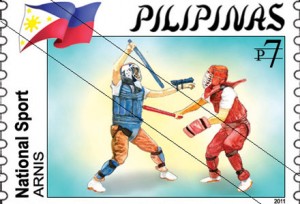
‘Arnis’ on Philippine Stamps

arnis_ss-1

  ‘Arnis’ can now be seen on Philippine stamps QUEZON CITY, METRO MANILA- The Philippine Postal Corporation (PhilPost) recently released stamps featuring ‘arnis,’ a Filipino martial arts and the country’s national sport. This is part of efforts to promote the sport throughout the world, the PhilPost said. The special ‘arnis’ stamps capture the unique movement and artistry of this Filipino sport, said PhilPost Postage and Philatelic department manager Lenie San Diego. … [Read more...]

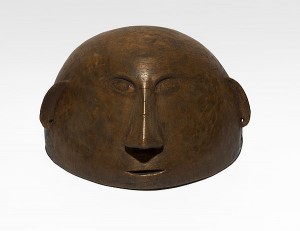
Warrior’s Helmet (Oklop), Ifugao, 19th-early 20th c., National Gallery of Australia.

mandirigma kali arnis eskrima luzon visayas mindanao mandirigma kali arnis eskrima luzon visayas mindanao

Warrior’s Helmet (Oklop), Ifugao, 19th-early 20th c., National Gallery of Australia.   Courtesy of http://pupuplatter.tumblr.com … [Read more...]

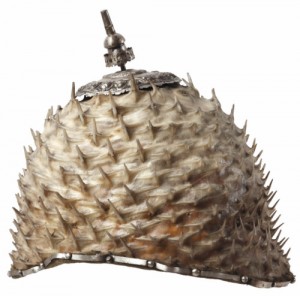
Helmet, Masbate, 19th c., Museo Nacional de Antropología, Madrid.

7 mandirigma kali arnis eskrima luzon visayas mindanao

Helmet, Masbate, 19th c., Museo Nacional de Antropología, Madrid.   Courtesy of http://pupuplatter.tumblr.com … [Read more...]

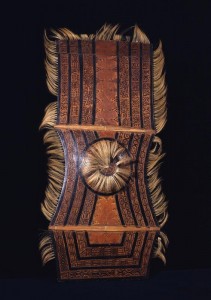
Shield, Bagobo, c 1900-1910, Penn Museum.

6 mandirigma kali arnis eskrima luzon visayas mindanao 6 mandirigma kali arnis eskrima luzon visayas mindanao

Shield, Bagobo, c 1900-1910, Penn Museum.   Courtesy of http://pupuplatter.tumblr.com … [Read more...]

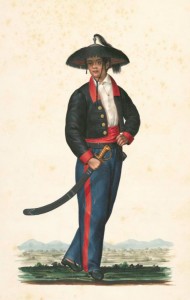
Justiniano Asuncion, “A Guardia de Vino: An Officer to Look After the Government Monopolies, Such as Arrack and Tobacco,” c 1841, New York Public Library.

5 4 mandirigma kali arnis eskrima luzon visayas mindanao 5 4 mandirigma kali arnis eskrima luzon visayas mindanao 5

  Justiniano Asuncion, “A Guardia de Vino: An Officer to Look After the Government Monopolies, Such as Arrack and Tobacco,” c 1841, New York Public Library.   Courtesy of http://pupuplatter.tumblr.com … [Read more...]

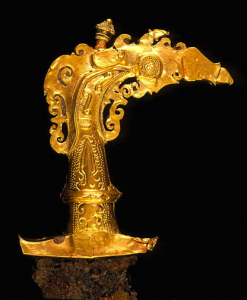
Dagger Hilt, Butuan, 10th-13th c., Tony and Cecile Gutierrez Collection.

4 mandirigma kali arnis eskrima luzon visayas mindanao 4 4 mandirigma kali arnis eskrima luzon visayas mindanao 4

Dagger Hilt, Butuan, 10th-13th c., Tony and Cecile Gutierrez Collection.   Courtesy of http://pupuplatter.tumblr.com … [Read more...]

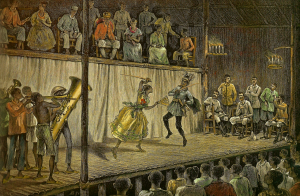
Joseph Montano, “Moros-Moros au Théâtre d’Albay,” 1886.

mandirigma kali arnis eskrima luzon visayas mindanao 3 mandirigma kali arnis eskrima luzon visayas mindanao 3

Joseph Montano, “Moros-Moros au Théâtre d’Albay,” 1886.   Courtesy of http://pupuplatter.tumblr.com … [Read more...]

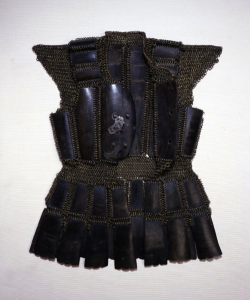
Body Armor, Lanao del Sur, late 19th-early 20th c., British Museum.

mandirigma kali arnis eskrima luzon visayas mindanao 2 mandirigma kali arnis eskrima luzon visayas mindanao 2

Body Armor, Lanao del Sur, late 19th-early 20th c., British Museum.   Courtesy of http://pupuplatter.tumblr.com … [Read more...]

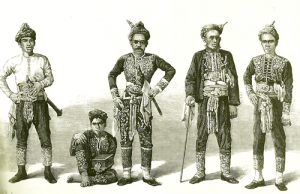
“Comisión encargada por el Sultán de Joló de visitar al Capitán General de las Islas Filipinas,” La Ilustración Española y Americana,” 1879.

mandirigma kali arnis eskrima luzon visayas mindanao mandirigma kali arnis eskrima luzon visayas mindanao

“Comisión encargada por el Sultán de Joló de visitar al Capitán General de las Islas Filipinas,” La Ilustración Española y Americana,” 1879.   Courtesy of http://pupuplatter.tumblr.com … [Read more...]

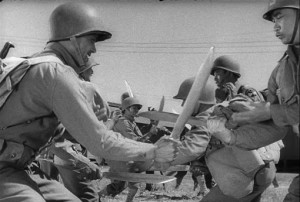
U.S. Army 1st & 2nd Filipino Infantry Regiments training in California during World War II.

10600663_10205291801962660_5087962132271676801_n

U.S. Army 1st & 2nd Filipino Infantry Regiments training in California during World War II.   http://www.criticalpast.com/video/65675053496_Filipino-Infantry_recreational-activities_bolo-knives_Colonel-Robert-Offley   … [Read more...]

A French Documentary about Arnis in the 1950′s

A French Documentary about Arnis in the 1950's http://www.youtube.com/watch?v=HZg2i6Yq9rc … [Read more...]

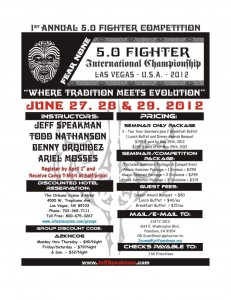
Kapisanang Mandirigma Member Guro Ariel Flores Mosses to teach at Jeff Speakman’s 5.0 Fighter Event, Las Vegas, Nevada, USA. June 27, 28, 29 – 2012

kali arnis eskrima

Kapisanang Mandirigma Member Guro Ariel Flores Mosses to teach at Jeff Speakman's 5.0 Fighter Event Kapisanang Mandirigma Member Guro Ariel Flores Mosses to teach at Jeff Speakman's 5.0 Fighter Event Las Vegas, Nevada, USA. June 27, 28, 29 - 2012     Guro Ariel Flores Mosses: About Guro Ariel: Guro Ariel F. Mosses has over 30 years of Filipino Martial Arts experience. He has trained under Filipino Hall of Fame Grand Master Conrad A. Manaois, the late Punong Guro Edgar G. Sulite, and Grand Master Christopher Ricketts of Kali Ilustrisimo. Guro Mosses is the Vice President and Chief Instructor for Manaois Systems International. He holds a 7th degree in Kali Jukune Do. Guro Ariel is a member of Kapisanang Mandirigma. He has experience as a professional bodyguard and is a former police officer. Guro Ariel is currently teaching at LV Tactical Training in Las Vegas, Nevada. Guro Ariel will be one of the instructors at Jeff Speakman’s 5.0 Fighter Event Las Vegas, Nevada, USA. June 27, 28, 29 – 2012. . http://mandirigma.org/?p=1537 To contact Guro Ariel go to: http://www.lvtacticaltraining.com/   http://www.youtube.com/watch?v=oeyr9T6qD34 … [Read more...]

Bladed Weapons, Mindanao, 19th c., Museo Nacional De Antropología, Madrid.

Bladed Weapons, Mindanao, 19th c., Museo Nacional De Antropología, Madrid.

Bladed Weapons, Mindanao, 19th c., Museo Nacional De Antropología, Madrid.   Courtesy of http://pupuplatter.tumblr.com … [Read more...]

Kalis Ilustrisimo Headquarters aid for Grandmaster Tony Diego

GM Ilustrisimo Diego

To all our Kalis Ilustrisimo brothers and sisters, On the morning of February 24, 2012 a fire raged through a small community in Manila. Many houses were razed to the ground leaving families homeless. We received sad news that the home of Master Tony Diego was among those houses that didn't survive the fire. Absolutely none of their possessions were saved except the clothes on their backs. Master Tony and family are alive and safe but in dire need of assistance. Since the fire, they have been given temporary shelter at the local community center. We would like to solicit the immediate help of our brothers and sisters in Kalis Ilustrisimo and other kind souls to send aid for Master Tony and his family. Since Master Tony has no home at the moment, donations in kind may pose a problem. Instead, cash donations would be preferred and much appreciated. All parties who would like to make a donation are requested to send us a private message on our facebook page or email us at kalis.ilustrisimo.hq@gmail.com so that we can make arrangements to receive your donation. Thank you! Kalis Ilustrisimo Headquarters … [Read more...]

Guro Ariel Flores Mosses

ariel mosses kali arnis eskrima manaois lameco ilustrisimo mandirigma.org ariel mosses kali arnis eskrima manaois lameco ilustrisimo mandirigma.org Guro Ariel Flores Mosses: About Guro Ariel: Guro Ariel F. Mosses has over 30 years of Filipino Martial Arts experience. He has trained under Filipino Hall of Fame Grand Master Conrad A. Manaois, the late Punong Guro Edgar G. Sulite, and Grand Master Christopher Ricketts of Kali Ilustrisimo. Guro Mosses is the Vice President and Chief Instructor for Manaois Systems International. He holds a 7th degree in Kali Jukune Do. He has experience as a professional bodyguard and is a former police officer. To contact Guro Ariel go to: http://www.lvtacticaltraining.com/ lameco ariel mosses kali arnis eskrima manaois lameco ilustrisimo mandirigma.org lameco ariel mosses kali arnis eskrima manaois lameco ilustrisimo mandirigma.org ariel mosses kali arnis eskrima manaois lameco ilustrisimo mandirigma.org ariel mosses kali arnis eskrima manaois lameco ilustrisimo mandirigma.org Guro Ariel Flores Mosses: About Guro Ariel: Guro Ariel F. Mosses has over 30 years of Filipino Martial Arts experience. He has trained under Filipino Hall of Fame Grand Master Conrad A. Manaois, the late Punong Guro Edgar G. Sulite, and Grand Master Christopher Ricketts of Kali Ilustrisimo. Guro Mosses is the Vice President and Chief Instructor for Manaois Systems International. He holds a 7th degree in Kali Jukune Do. He has experience as a professional bodyguard and is a former police officer. To contact Guro Ariel go to: http://www.lvtacticaltraining.com/ lameco ariel mosses kali arnis eskrima manaois lameco ilustrisimo mandirigma.org lameco ariel mosses kali arnis eskrima manaois lameco ilustrisimo mandirigma.org

Guro Ariel with Grandmaster Manois in Washington State, 1998  Guro Ariel Flores Mosses: About Guro Ariel: Guro Ariel F. Mosses has over 30 years of Filipino Martial Arts experience. He has trained under Filipino Hall of Fame Grand Master Conrad A. Manaois, the late Punong Guro Edgar G. Sulite, and Grand Master Christopher Ricketts of Kali Ilustrisimo. Guro Mosses is the Vice President and Chief Instructor for Manaois Systems International. He holds a 7th degree in Kali Jukune Do. Guro Ariel is a member of Kapisanang Mandirigma. He has experience as a professional bodyguard and is a former police officer. Guro Ariel is currently teaching at LV Tactical Training in Las Vegas, Nevada. Guro Ariel will be one of the instructors at Jeff Speakman’s 5.0 Fighter Event Las Vegas, Nevada, USA. June 27, 28, 29 – 2012. . http://mandirigma.org/?p=1537 To contact Guro Ariel go to: http://combatfma.com/index.html http://www.lvtacticaltraining.com/     http://www.youtube.com/watch?v=oeyr9T6qD34   Grandmaster Manois Tournament and Official at FACLA Historic Filipinotown, Los Angeles, 2000     Guro Ariel with student at his school Washington State, Guro Ariel, Guro Dino, Grandmaster Conrad Manaois and daughter, Historic Filipinotown, Los Angeles, 1998     Guro Ariel Flores Mosses, Punong Guro Sulite, Guro Choy Flores, Guro Dino Flores in Washington State Guro Ariel Flores Mosses with Master Ricketts in Washington State Guro Ariel Flores Mosses with Master Ricketts, Maste Galang, Master Dodong in Washington State Guro Ariel and Guro Dino being filmed by student Ron Gabriel. Location in the backyard of Guro Ariel's Mothers house in Los Angeles, 2000 Guro Ariels Lameco I.D. Number one for Washington State and Lameco Representative. 1995 … [Read more...]

Lameco Eskrima & Kali Ilustrisimo – Seminar mit Guro Dino Flores/USA presented by Kapisanang Mandirigma Germany

fma filipino martial arts fma filipino martial arts fma filipino martial arts fma filipino martial arts

Lameco Eskrima & Kali Ilustrisimo – Seminar mit Guro Dino Flores/USA presented by Kapisanang Mandirigma Germany Lameco Eskrima & Kali Ilustrisimo – Seminar mit Guro Dino Flores/USA presented by Kapisanang Mandirigma Germany sponsored by JuWe-Sticks Nach der überwältigenden Resonanz nach dem letzten Kurzbesuch von Guro Dino freuen wir uns Ihn in 2012 für einen längeren Aufenthalt gewinnen zu können. Das Seminar bildet die Grundlage für ein tieferes Verständnis des Kali Ilustrisimo (CNR) und des Lameco Eskrima (SOG) sowie den Start von Kapisanang Mandirigma Germany. Thema wird sein: Kali Ilustrisimo (Single & Double Blade) – Lameco Eskrima (Single & Double Stick) Laßt euch die Gelegenheit Kali Ilustrisimo von einem der wenigen zertifizierten Instruktoren unter Master Christopher Ricketts sowie Punong Guro Edgar. G. Sulite zu lernen nicht entgehen. KOSTEN: 1 Tag 55€ – 2 Tage 100€ bei Zahlung vor 13.04.2012, danach plus 10€ Nachmeldegebühr Seminarort wird noch bekanntgegeben, voraussichtlich Frankfurt/Main. Bei Nichterscheinen verfällt die bereits gezahlte Seminargebühr. Der Veranstalter übernimmt für Personen- und Sachschäden keinerlei Haftung. Die Teilnahme erfolgt auf eigenes Risiko! … [Read more...]

The first written account of “KALI” as the pre-Hispanic name of the Filipino Martial Arts by FMA History Redux

The first written account of "KALI" as the pre-Hispanic name of the Filipino Martial Arts Source: http://fmahistoryredux.blogspot.com/2014/11/the-first-written-account-of-kali-as.html?spref=fb http://fmahistoryredux.blogspot.com/2014/11/philippine-hero-rev-fr-gregorio-aglipay.html “Mga Karunungan sa Larong Arnis” by Placido Yambao and Buenaventura Mirafuente, University of the Philippines Press, 1957... the first book on the Filipino Martial Arts that we know now... its section on the history of the Filipino Martial Arts stated that when the Spaniards arrived in the Philippines, Filipino Martial Arts was not yet called "ARNIS" but "KALI" (“Ang KALI na dinatnan ng mga Kastila ay hindi pa ARNIS ang tawag noong 1610")... The book also mentioned that a KALI demonstration was once performed in honor of the newly-arrived Conquistador Miguel Lopez de Legazpi on the order of a tribal leader in the Island of Leyte...     Philippine Hero Rev. Fr. Gregorio Aglipay, the source of Yambao & Mirafuente's "KALI"...   REV. FR. GREGORIO AGLIPAY, 1860-1940 (center), the first Supreme Bishop of the Philippine Independent Church (Wikipedia photo)...Rev. Fr. Aglipay was the source of the information that the original name of the Filipino Martial Arts is KALI in the book “Mga Karunungan sa Larong Arnis” authored by Placido Yambao and Buenaventura Mirafuente (University of the Philippines Press, 1957):'Ang KALI na Dinatnan ng mga Kastila ay Hindi pa Arnis ang Tawag nuong 1610.... Noong unang panahon ang larong ito'y kilala sa tawag na "KALI" ng ating mga ninuno, nguni't sa hindi maiwasang pagbabago ng panahon at pangyayari (underscoring mine) ay pinamagatan nila ng "Panandata" sa Tagalog, "Pagkalikali" sa kapatagan ng Kagayan ng mga Ibanag, "Kalirongan" sa Pangasinan, "Kaliradman" sa Bisaya at "Pagaradman" sa Ilongo nuong 1860, at "Didya" sa Ilokos at muling naging "Kabaroan," ayon kay Rev. Fr. Gregorio Aglipay na bantog din sa arnis nuong 1872.'TRANSLATION: 'The indigenous martial art that the Spanish encountered in 1610 was not yet called Arnis at that time. During those times, this martial art was known as "KALI" to our ancestors.  Due to theunavoidable changing of the times and circumstances (underscoring mine), this martial art became known as "Panandata" to the Tagalogs, "Pagkalikali" to the Ibanags of the plains of Cagayan, "Kalirongan" to the people of Pangasinan, "Kaliradman" to the Visayans, "Pagaradman" to the Ilonggos in 1860, and "Didya" to the Ilocanos (but later on changed to "Kabaroan").  This is according to Rev. Fr. Gregorio Aglipay, who himself was a famous Arnis practitioner in 1872.' … [Read more...]

Indigenous peoples of the Philippines

kali arnis eskrima escrima lameco sulite mandirigma.org

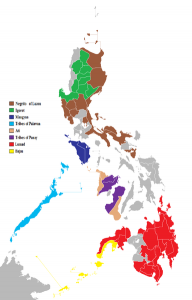
Indigenous peoples of the Philippines From Wikipedia, the free encyclopedia The indigenous peoples of the Philippines consist of a large number of indigenous ethnic groups living in the country. They are the descendants of the original inhabitants of the Philippines who have managed to resist centuries of Spanish and United States colonization and in the process have retained their customs and traditions.[1] In the 1990s, there were more than 100 highland tribal groups constituted approximately 3% of the population. The upland tribal groups were a blend in ethnic origin like other lowland Filipinos, although they did not have contact with the outside world. They displayed a variety of social organization, cultural expression and artistic skills. They showed a high degree of creativity, usually employed to embellish utilitarian objects, such as bowls, baskets, clothing, weapons and spoons. These groups ranged from various Igorot tribes, a group that includes the Bontoc, Ibaloi, Ifugao, Isneg, Kalinga and Kankana-ey, who built the Rice Terraces. They also covered a wide spectrum in terms of their integration and acculturation with lowland Christian and Muslim Filipinos. Native groups such as the Bukidnon in Mindanao, had intermarried with lowlanders for almost a century. Other groups such as the Kalinga in Luzon have remained isolated from lowland influence. There were several indigenous groups living in the Cordillera Central of Luzon in 1990. At one time it was employed by lowland Filipinos in a pejorative sense, but in recent years it came to be used with pride by native groups in the mountain region as a positive expression of their ethnic identity. The Ifugaos of Ifugao Province, the Bontocs, Kalinga, Tinguian, the Kankana-ey and Ibaloi were all farmers who constructed the rice terraces for many centuries. Other mountain peoples of Luzon are the Isnegs of northern Kalinga-Apayao Province, the Gaddangs of the border between Kalinga-Apayao, and Isabela provinces and the Ilongots of Nueva Vizcaya Province and Caraballo Mountains all developed hunting and gathering, farming cultivation and headhunting. Other indigenous people such as the Negritos formerly dominated the highlands throughout the islands for thousands of years, but have been reduced to a small population, living in widely scattered locations, primarily along the eastern ranges of the mountains. In the southern Philippines, upland and lowland tribal groups were concentrated on Mindanao and western Visayas, although there are several indigenous groups such as the Mangyan living in Mindoro. Among the most important groups found on Mindanao are collectively called the Lumad, and includes the Manobo, Bukidnon of Bukidnon Province, Bagobo, Mandaya, and Mansaka, who inhabited the mountains bordering the Davao Gulf; the Subanon of upland areas in the Zamboanga; the Mamanua in the Agusan-Surigao border region; the Bila-an, Tiruray and Tboli in the region of the Cotabato province, and the Samal and Bajau in the Sulu Archipelago. The tribal groups of the Philippines are known for their carved wooden figures, baskets, weaving, pottery and weapons. Reservation The Philippine government succeeded in establishing a number of protected reservations for tribal groups. Indigenous people were expected to speak their native language, dress in their traditional tribal clothing, live in houses constructed of natural materials using traditional architectural designs and celebrate their traditional ceremonies of propitiation of spirits believed to be inhabiting their environment. They are also encouraged to re-establish their traditional authority structure in which, as in indigenous society were governed by chieftains known as Rajah and Datu. Contact between "primitive" and "modern" ethnic groups usually resulted in weakening or destroying tribal culture without assimilating the indigenous groups into modern society. It seemed doubtful that the shift of the Philippine government policy from assimilation to cultural pluralism could reverse the process. Several Filipino tribes tends to lead to the abandonment of traditional culture because land security makes it easier for tribal members to adopt the economic process of the larger society and facilitates marriage with outsiders. In the past, the Philippine government bureaus could not preserve tribes as social museum exhibits, but with the aid of various nationwide organizations, they hoped to help the tribes adapt to modern society without completely losing their ethnic identity.   … [Read more...]

A timeline of Indochina and Indonesia by Piero Scaruffi, 206 BC – Jan 2012 – Copyright © 2011 Piero Scaruffi All rights reserved.

A timeline of Indochina and Indonesia by Piero Scaruffi http://www.scaruffi.com/politics/indochin.html 206 BC: the kingdom of the Nam Viet dynasty extends from Vietnam to Canton 257 BC: An Doung Voung (Thuc Phan) unifies tribes of Vietnam and creates the kingdom of Auc Lac with his capital at Phuc An 208 BC: Chao To create the kingdom of Namviet in northern Vietnam 111 BC: China annexes the kingdom of Namviet 1## AD: an Indian brahmin founds the kingdom of Funan, with capital in Vyadhapura 192 AD: China expands into Vietnam to the border with the Champa empire 221 AD: China is unified and begins expanding south 529 AD: Rudrawarman founds a new dynasty in Champa 50#: the Srivijaya kingdom is founded in southern Sumatra (Indonesia) with capital in Palembang and Buddhism as the state religion 55# AD: the kingdom of Chenla (north Cambodia) annexes Funan (south Cambodia) 572: Sambhuvarman becomes king of Vietnam and builds monuments at Mi Son 58#: the Srivijaya kingdom expands on Java 605: China captures the Champa capital Trakieu 612: first inscriptions in the Khmer language 616: Isanavarman I becomes king of Chenla 627: Isanavarman I annexes Funan and northwest Cambodia 653: Prakasadharma becomes king of Cham and builds the Hinduist temples of My Son (Vietnam) 65#: the Nanchao kingdom forms in northern Burma 657: Jayavarman I of Chenla conquers north Laos and founds the Khmer dynasty 686: the Srivijaya kingdom expands over Sumatra (Indonesia) and the Malay peninsula 7##: the Sailendra, allied of Srivijaya, rule in central Java 717: the Chenla kingdom collapses and falls under the influence of the Sailendra 732: Sanjaya founds the Sanjaya dynasty in central Java (Indonesia) with capital in Mataram (central Java) 778: Sailendra king Dharmatunga begins construction of the Buddhist temple at Borobudur in Java (Indonesia) 791: the Nanchao kingdom (north Burma) expands under I-mou-hsun 802: Jayavarman II liberates the Khmers from Javanese domination and founds a new Hinduist kingdom in Cambodia, Angkor, with capital near Seam Reap (Roluos ruins) 82#: Sailendra king Samaratunga completes construction of the Buddhist temple at Borobudur in Java (Indonesia) 825: the kingdom of Pegu (south Burma) moves its capital at Hamsavati 832: the Nanchao kingdom (north Burma) subdues the Pyu people 832: the Sanjaya kingdom annexes the Sailendra kingdom in Java (Indonesia) 875: a new Champa kingdom is founded at Indrapura/ Quangnam under king Indravarman I who protects Buddhism 877: Indravarman I of Khmer creates a network of irrigation in Cambodia and builds the temples of Bakong and Preah Ko 889: Yasovarman I founds the city of Angkor 893: Indravarman II founds a new Champa dynasty 898: Sanjaya king Balitung of Mataram restores Hinduism in Central Java 907: China's domination of Indochina ends 910: Sanjaya king Daksa begins construction of the Hindu temples at Prambanan in Java (Indonesia) dedicated to Shiva 910: Yashovarman I establishes the Khmer capital at Yashodharapura (Angkor) 921: Jayavarman IV usurpes the throne of Khmer and moves the capital to Koh Ker 929: Sindok founds a new dynasty in East Java 938: Ngo Quyen liberates Vietnam from China at the battle of Bach Dang 939: Ngo Quyen declares the independence of Namviet and founds the kingdom of Annam (north Vietnam) 944: Rajendravarman becomes king of Khmer and moves the capital back to Angkor 950: the Khmer kingdom expands from Cambodia to Burma, Laos and Siam 968: Champa king Dinh Bo Linh founds the Dinh dynasty and moves the capital to Hoa Lu (Vietnam) 979: Annam's king Le Hoan founds the first Le dynasty in Vietnam 979: Champa (south Vietnam) king Paramesvaravarman attacks Annam (north Vietnam), the beginning of five centuries of warfare, but is defeated and killed 982: Annam's king Le Hoan captures the Champa capital Indrapura and the Champa kingdom moves its capital to Vjaya 982: 979: Annam's king Le Hoan captures the Champa capital Indrapura and the Champa kingdom moves its capital to Vjaya 985: Sanjaya king Dharmavamsa conquers Bali (Indonesia) 988: Harivarman II founds a new Champa kingdom with capital in Vijaya 1006: the Srivijaya kingdom of southern Sumatra (Indonesia) attacks Sanjaya, destroys Mataram (Central Java) and kills Dharmavamsa 1010: the Ly dynasty succeeds the Le dynasty and moves the capital of Annam to Thanh Long (Hanoi) 1019: Dharmavamsa's son-in-law Airlangga founds the Kahuripan kingdom in East Java (Indonesia) and invades Bali 1030: Airlangga annexes the kingdom of Srivijaya (Indonesia) through marriage but divides his kingdom between his sons (kingdoms of Janggala and Kediri) 1030: the Chola of India raid Srivijaya 1044: Annam raids the Champa capital and kills the Champa king in Vietnam 1049: Airlangga retires in a monastery and divides his kingdom between his two sons 1050: Udayadityavarman becomes king of Khmer and the empire reaches its peak (Cambodia, south Laos, south … [Read more...]

Hospecio Balbuena Balani, Jr. segment from the book “Masters of the Blade” by Master Rey Galang, 2006

guro bud balani 1 lameco ilustrisimo mandirigma.org guro bud balani 1 lameco ilustrisimo mandirigma.org

                    … [Read more...]

Arnis Boosts Fil-Am’s Sense of Pride – by Volt Contreras for The Philippine Daily Inquirer Newspaper Interviews Guro Arnold Noche, October 4, 2006

Arnold A. Noche is one of the remaining survivors of Lameco SOG under the late Punong Guro Edgar G. Sulite of Lameco Eskrima International and is also a co-founder and instructor of Kapisanang Mandirigma. He made a recent visit to the Philippines to attend the 3rd World FMA Festival and Bakbakan International Invitational Tournament. Kali Klub, a project of Kapisanang Mandirigma, has received numerous awards and commendations from the City of Los Angeles, City of Walnut and State of California since the inception of the program in 1999. The Philippine Daily Inquirer is undeniably the country's most widely read and circulated newspaper. With over 2.7 million nationwide readers daily, it enjoys a market share of over 50% and tops the readership surveys. Not only is it the most read among  all sectors and ages, it is also the country's most trusted source of hard-hitting news and countless expos's. Distinguished by award-giving bodies like the Catholic Mass Media Awards, Jaime Ongpin Awards for Investigative Journalism and Anvil Awards, it is the Philippines' most awarded broadsheet with over 200 awards and citations. Arnis Boosts Fil-Am’s Sense of Pride By Volt Contreras Philippine Daily Inquirer Published on Page A1 of the October 4, 2006 issue of the Philippine Daily Inquirer. CROSSING land bridges that once linked the Philippine archipelago to the Asian mainland, ancient fighters introduced to Filipinos a form of martial arts believed to have come from India and now called kali, eskrima and arnis de mano. Yes, those rattan canes - and the graceful moves that make them lethal - are that old, according to generally held notions as to the origins of the Pinoy warrior art. With a deep sense of history, a Filipino-American based in California since the late '60s considers his mastery of kali (considered the pre-Spanish name for arnis or eskrima) as a bridge to the country of his birth - and hopes that more Fil-Am’s would join him in paying ambidextrous homage to their shared cultural roots. Arnold Noche has been taking time from his business each week, driving up to 48 kilometers from his home in the Gardena suburb, to conduct two-hour training sessions for kali enthusiasts of all ages at Filipino community centers in Los Angeles. "There's something about a stick in the hand that is very Filipino", noted Noche Noche and other "backyard" eskrimadors started the Kali Klub project in 1999 and have since taught an average of 250 students a year, around 90 percent of them Fil-Am’s aged 5 to over 40. Kali Klub sa FilAm ARTS Since 2004, Kali Klub has been conducting classes in partnership with FilAm Arts (Association for the Advancement of Filipino American Arts & Culture), a nonprofit, multidisciplinary arts organization located on N. Vermont Avenue in LA. Dealing with Confusion "I could have taught my (Fil-Am) students something else to help them deal with whatever confusion they may have about their cultural identity. But I am an eskrimador, and this is my way of helping them understand the complexities of being a Fil-Am," Noche said. His family moved to the States when he was only 2 years old. At age 8 he began studying karate and, at age 12, picked up his first kali sticks - henceforth earning bruises and scars in a discipline that would "control my life." At 40, Noche runs his own management consultancy and multimedia firm ATF1898 - a proud reference to the year Filipinos declared their independence from Spain. But in a recent Inquirer interview in Manila, he said he would rather be counted as a member of the "Filipino warrior class." He was referring to the disciples of an ancient art that had been in progression long before foreign powers reached Philippine soil. Employing real swords or knives in its original form, kali survived by being "secretly practiced" during colonial times when Filipinos were prohibited from carrying weapons. "It has been handed down from one generation to another, and has eventually made its way around the world. Now it is not only practiced by thousands of martial artists but also favored by elite military and law enforcement groups," Noche said. Action Flicks Further proof of its global appeal, he noted, is the growing number of Hollywood action flicks that feature kali movements in their fight sequences. Matt Damon, for example, in an interview on the hand-to-hand combat style of his "Jason Bourne" character, pronounced it as "kay-lee," he  said. Vin Diesel had also acknowledged training in kali for his sci-fi flick, "The Chronicles of Riddick." "Mission Impossible 3" and "Lara Croft Tomb Raider: The Cradle of Life" featured brief fight scenes with the lead stars Tom Cruise and Angelina Jolie, respectively, "using Filipino fighting sticks," Noche said. And Noche has this to say about Star Wars" Yoda: "My impression was that his moves (with the dazzling light saber) were … [Read more...]

Majapahit Empire, 1293 – 1500.

mandirigma.org